Havasupai Waterfalls: Complete Guide to Havasu Creek & All Five Falls
Havasupai Waterfalls are one of the most extraordinary natural wonders in the American Southwest. Hidden deep in Havasu Creek, this desert oasis surprises visitors with bright blue-green water, lush vegetation, and five stunning waterfalls flowing through a remote canyon. It feels unreal the first time you see it. This is not a simple sightseeing stop. Visiting Havasupai Waterfalls requires advance permits, careful planning, and a long hike into tribal land. There are no roads, no day trips, and no shortcuts. That is exactly why so many travelers dream about it—and why so many feel overwhelmed when planning. This guide is your complete starting point. It explains what Havasupai Waterfalls are, where they are located, how the five waterfalls fit together, and how to plan a realistic visit.
This article may contain affiliate / compensated links. For full information, please see our disclaimer here.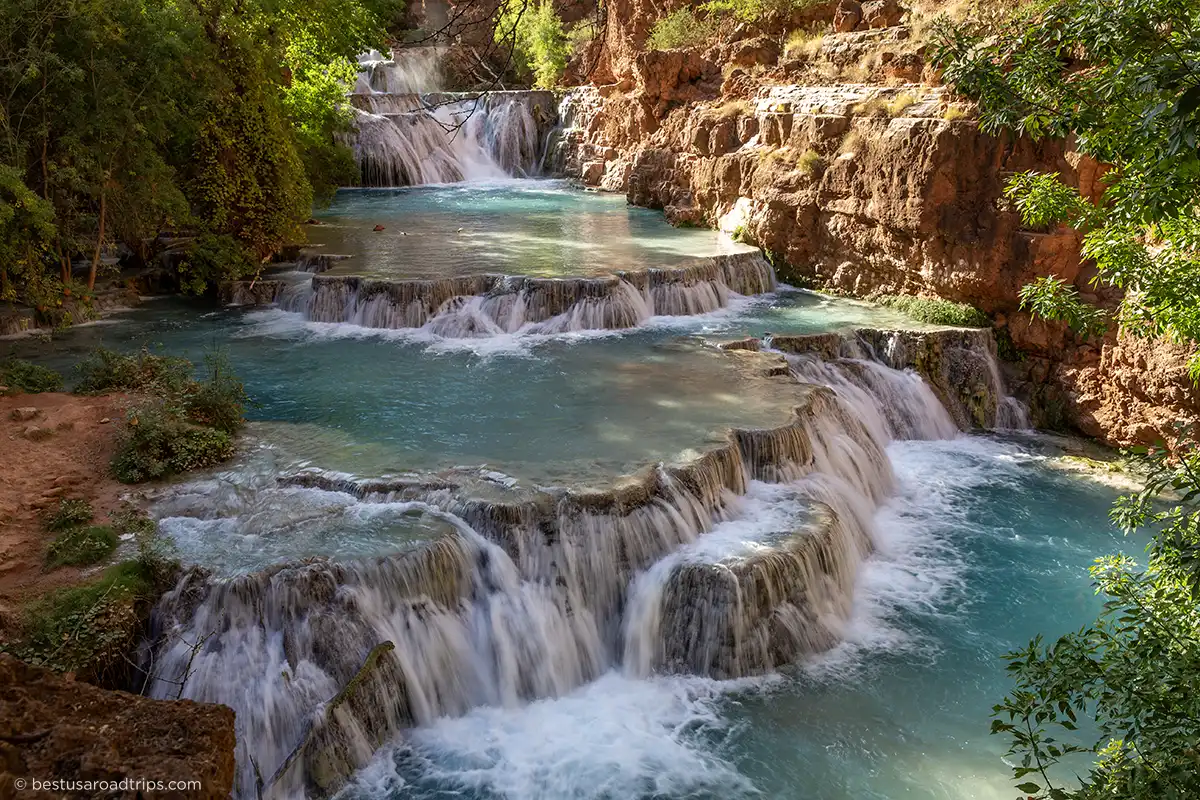
Our Experiences Visiting Havasupai Waterfalls
Chris and I have visited Havasupai Falls three times. Each trip was different. Different seasons, different water levels, different light, and very different conditions on the trail and at the campground.
After visiting Havasupai multiple times, it became clear how much misinformation circulates online and how critical proper planning really is.
Along the way, we camped beside Havasu Creek, swam beneath all five waterfalls, and spent long days hiking between them. Conditions changed dramatically from trip to trip—cool fall mornings, intense desert heat, and the quiet stillness of early mornings before most visitors arrived.
Photography became one of our favorite activities here. We photographed all five waterfalls at sunrise, midday, and sunset, and the changing light revealed just how photogenic and dynamic this place is. Few locations we’ve visited offer such dramatic water, color, and contrast throughout the entire day.
All photos in our Havasupai articles were taken by us during three separate visits over more than a decade, using different cameras. Keep in mind that each waterfall can look slightly different today, as flooding regularly reshapes the falls and surrounding landscape. The waterfalls also change throughout the year, with their appearance varying by month depending on water levels, flow strength, and seasonal conditions.

Your Havasupai Waterfalls Trip Planning Resources
After our third visit, we decided to create a full series of practical Havasupai articles. Not inspiration pieces, but real planning guides. Each article focuses on one part of the trip so nothing important gets missed.
In this pillar guide, we give you the big picture of Havasupai Waterfalls and Havasu Creek. When you are ready to go deeper, these articles walk you through every step:
- If you are still trying to go. Start with Havasupai Reservations: How to Get a Havasu Falls Permit. Permits are limited, competitive, and rule-driven. Understanding the system is essential before doing anything else.
- If you already have a permit. Read Havasu Falls Hike: Step-by-Step Guide to understand trail distance, elevation, water needs, check-in rules, and what the hike really involves.
- If you plan to camp. Use Havasu Falls Camping Guide and Rules to learn how to choose the best campsite, what facilities exist, and what is strictly prohibited.
- If you are packing and unsure what you really need. Follow Havasupai Packing List: What to Pack for the Havasu Falls Trip to avoid overpacking and prepare for heat, water, and remote conditions.
Everything we share is based on firsthand experience. The goal is simple: help you plan a safe, realistic, and unforgettable visit to Havasupai Waterfalls.
To see how this backpacking trip fits into a bigger plan, check our full Arizona itinerary and travel guide.
What Is Havasu Creek?
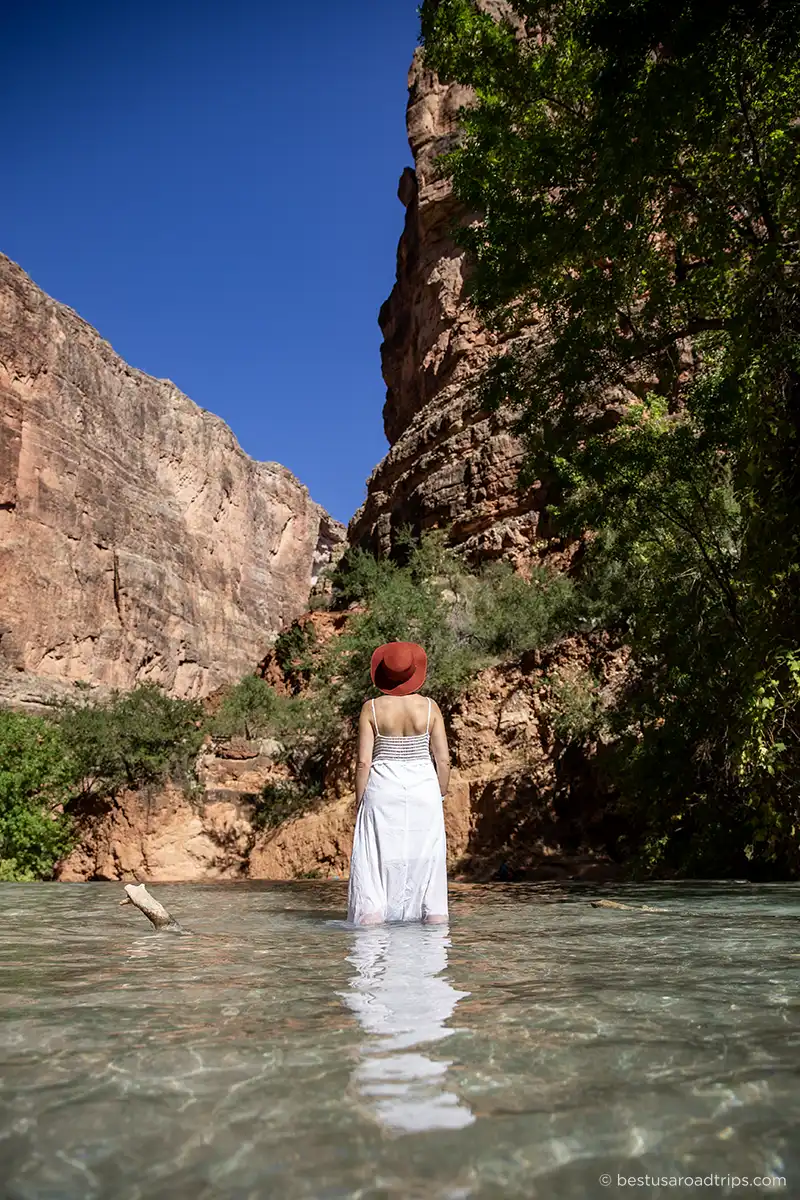
Havasu Creek is a desert stream flowing through a remote canyon in northwestern Arizona. It runs across the Havasupai Indian Reservation and eventually joins the Colorado River deep inside the Grand Canyon. This creek is the heart of the Havasupai Waterfalls area.
What makes Havasu Creek special is its bright blue-green color. The color comes from high levels of calcium carbonate in the water. Over time, these minerals form white travertine rock along the creek bed and waterfall edges. Sunlight reflecting off this limestone gives the water its unreal turquoise shade.
Unlike many desert streams in Arizona, Havasu Creek flows year-round. Natural springs feed the creek, so it does not dry up during summer. Water temperatures usually stay around 65–70°F, which makes swimming possible most of the year, even when air temperatures are cooler.
This unique mix of desert canyon, constant flowing water, and mineral-rich pools is what allows five major waterfalls to exist in one place.
It’s also important to understand land ownership here. Although Havasu Creek flows into the Colorado River within the Grand Canyon, Havasu Falls and the other Havasupai waterfalls are located on the Havasupai Tribe Reservation and are not part of Grand Canyon National Park.

Visiting Havasupai Tribal Land: What You Need to Know
Havasupai Waterfalls are located entirely on Havasupai Tribal land, not on federal land and not inside Grand Canyon National Park. The area is owned and managed by the Havasupai Tribe, whose people have lived in this region for centuries.
Because this is sovereign tribal land, different laws and rules apply. Entry is allowed only with a valid reservation issued by the Havasupai Tribe. National park passes, America the Beautiful passes, or backcountry permits from the National Park Service are not valid here.
All visitors must follow Havasupai Tribal rules and laws, including regulations related to:
- permits and check-in
- camping and lodging
- photography restrictions
- alcohol, drugs, and drones
- environmental protection
These rules are strictly enforced. Violations can result in fines, removal from the reservation, or permanent bans from future visits.
Cultural respect is just as important as legal compliance. Supai Village is a living community, not a tourist attraction. Photography of residents, homes, and community areas is prohibited unless explicit permission is given. Visitors are expected to act respectfully, keep noise levels low, and follow Leave No Trace principles at all times.
Understanding that you are a guest on tribal land helps set the right mindset for the entire trip. When visitors respect the land, the rules, and the people who live here, Havasupai remains one of the most special and protected places in the Southwest.

Overview of the Five Havasupai Waterfalls
Havasu Creek is home to five major waterfalls, all located within a relatively short stretch of the canyon. When people talk about “Havasu Falls,” they often mean the entire waterfall area—but Havasu Falls is only one of five waterfalls you can explore here.
With a valid Havasupai reservation, you have access to all five waterfalls. No additional permits are required to visit individual falls. Some are easy to reach, while others require extra hiking and careful navigation.
The five Havasupai waterfalls, listed in the order most visitors encounter them, are:
- Fifty Foot Falls – the closest waterfall to Supai Village
- Little Navajo Falls – formed after major flooding in 2008
- Havasu Falls – the most famous and most photographed waterfall
- Mooney Falls – the tallest waterfall, with a steep and exposed descent
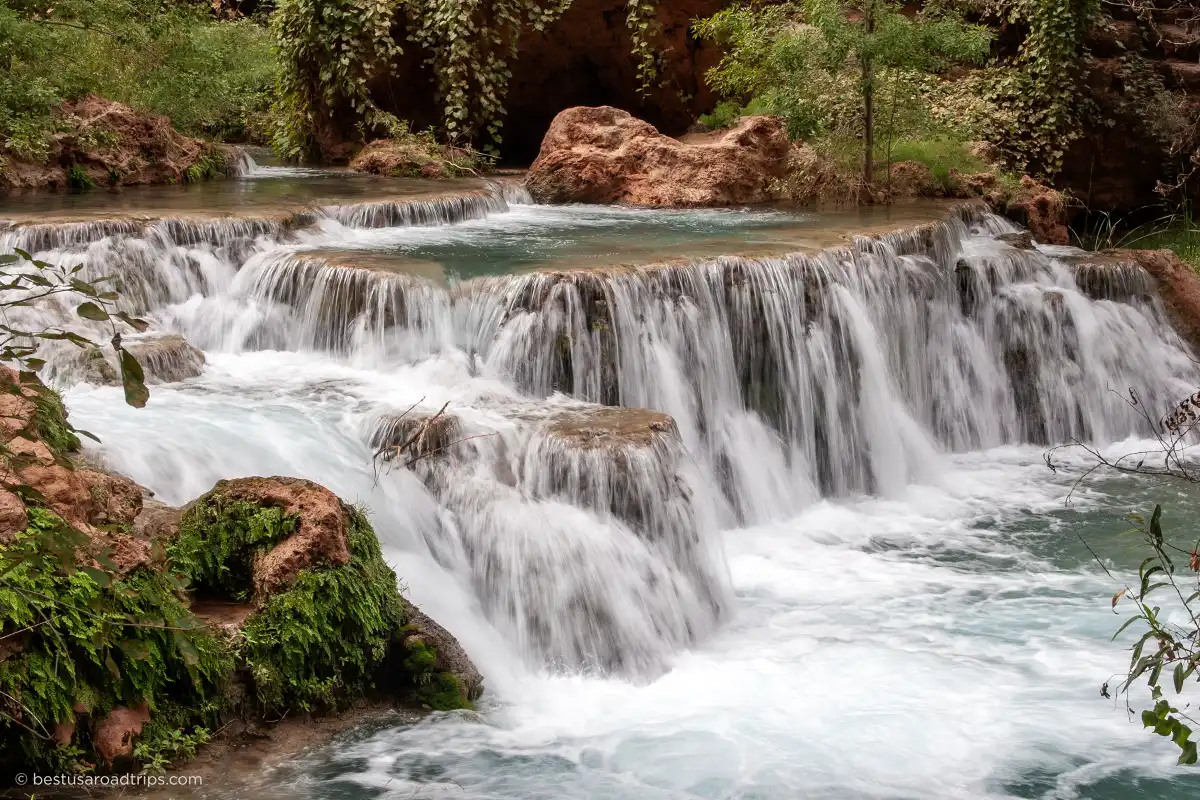
- Beaver Falls – the farthest waterfall, featuring a series of cascading pools
Each waterfall has a very different character. Some are ideal for swimming and relaxing. Others are more rugged and require experience, good footwear, and caution.
In the sections below, we give you a clear overview of each waterfall—what makes it special, where it’s located along Havasu Creek, and what to expect—without repeating detailed hiking instructions. Step-by-step access and safety details are covered in our dedicated guides.
Please also check the video below from the Havau Creek Waterfalls – it was recorded with a fantastic DJI Osmo Pocket camera.
Fifty Foot Falls
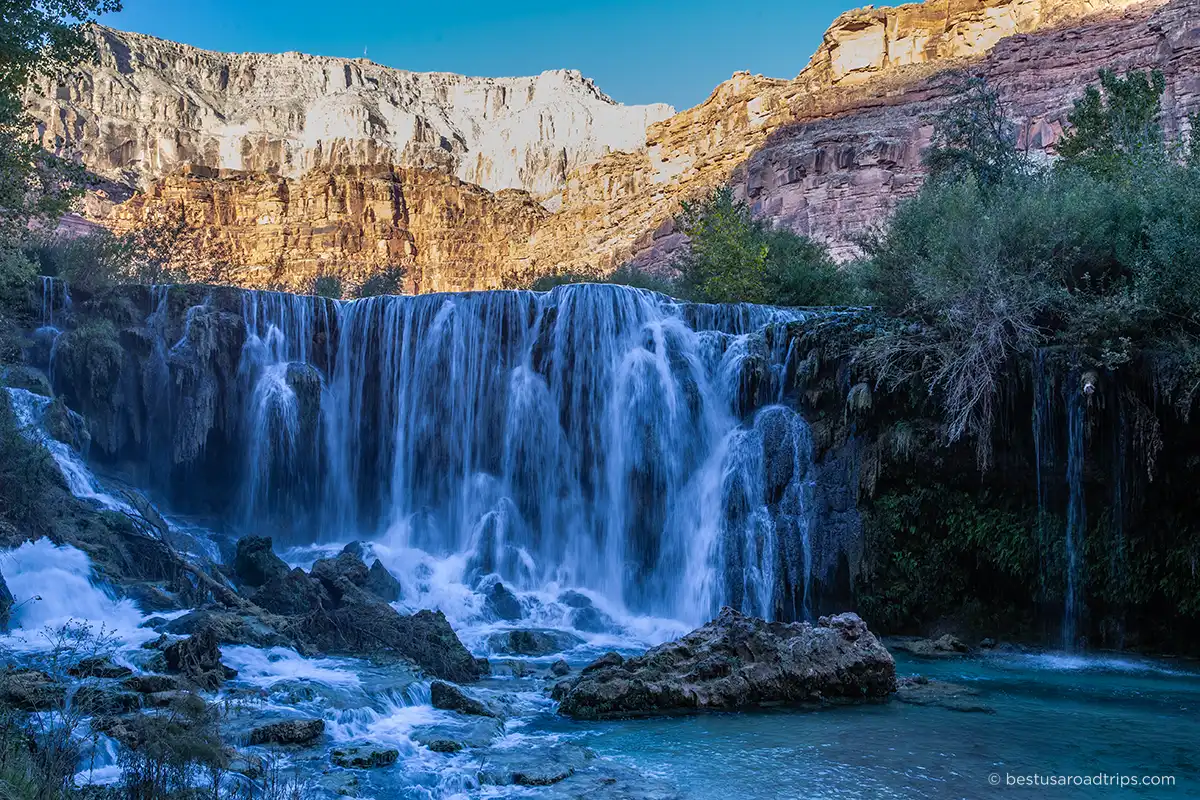
Fifty Foot Falls is the first major waterfall you encounter along Havasu Creek when traveling between Supai Village and the campground. It is sometimes called Upper Navajo Falls or New Navajo Falls, as its current shape became more prominent after the 2008 flood.
The waterfall drops roughly 50 feet into a rocky pool and is framed by red canyon walls and thick vegetation. Because it sits slightly off the main trail, many visitors walk past it without realizing how close it is. That makes it one of the least crowded waterfalls in the area.
Fifty Foot Falls is located:
- about 1 mile below Supai Village
- about 0.8 miles upstream from Havasu Falls
Access requires a short walk and a bit of route-finding through vegetation, but no technical skills. The pools below the falls are great for cooling off, especially on hot days, and the area feels quieter than the waterfalls closer to the campground.
This waterfall is a great first stop to slow down, explore, and appreciate Havasu Creek before reaching the more famous sites downstream.
Little Navajo Falls
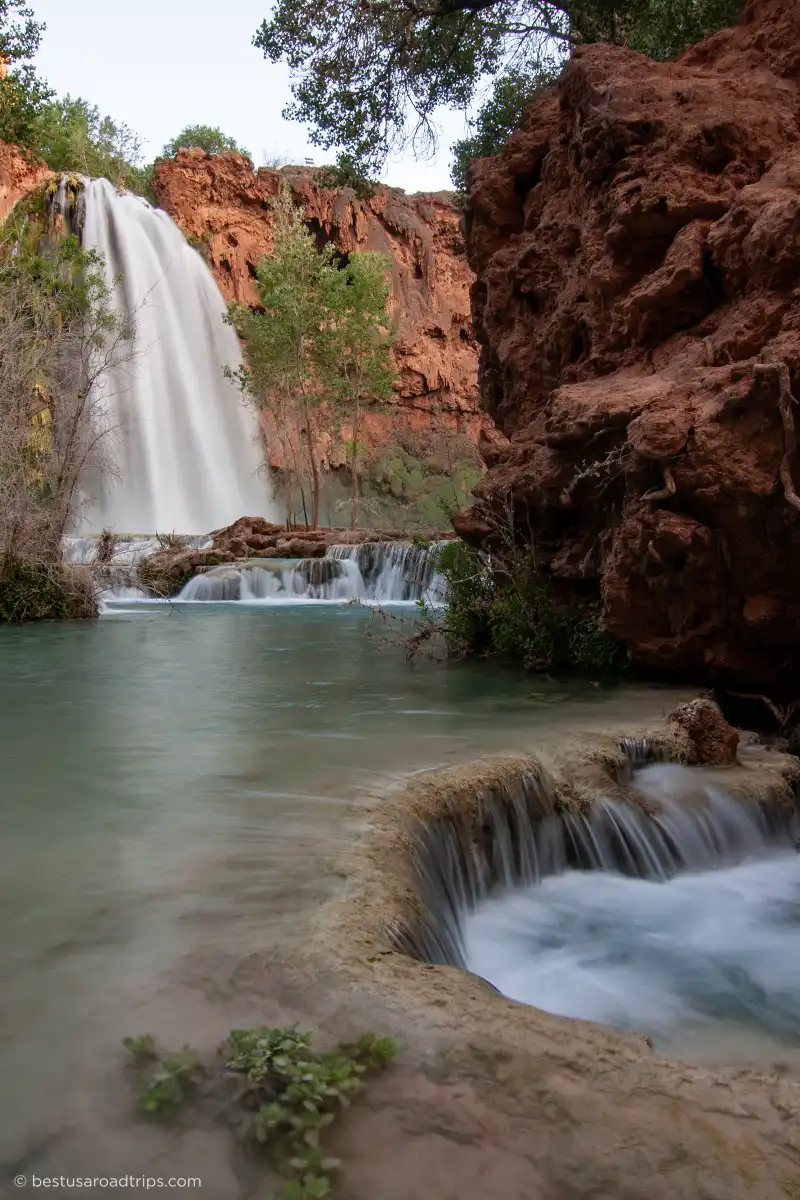
Little Navajo Falls, sometimes called Lower Navajo Falls, is one of the most enjoyable and accessible waterfalls along Havasu Creek. It was formed after the major flood in 2008, which reshaped the canyon and created several new cascades in this area.
This waterfall drops about 30 feet into a wide, calm pool with vivid blue-green water. The setting feels open and relaxed, making it a favorite spot for swimming and cooling off during warm days.
Little Navajo Falls is located:
- about 0.15 miles below Fifty Foot Falls
- roughly 1 mile from Havasu Falls Campground
- directly along the main trail between Supai Village and the campground
Reaching the base of the falls is easy. A short side path leads down to the pools, and no technical skills or scrambling are required. Because of its location, many hikers pass this waterfall on their way in or out and return later for a swim.
Little Navajo Falls is a great place to take a break, especially if you want a refreshing swim without committing to longer hikes or exposed terrain.

Havasu Falls
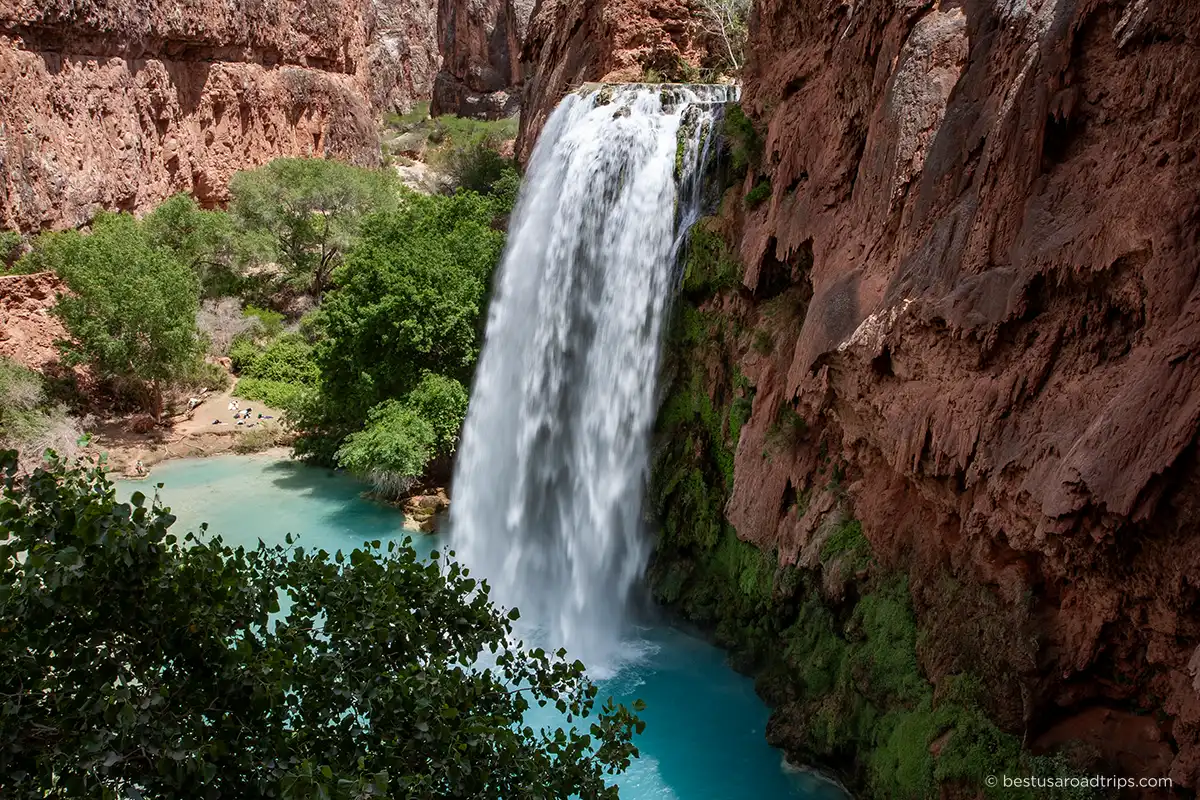
Havasu Falls is the most famous waterfall in the Havasupai area and the one most people picture when they hear the name. It is also why the entire region is often referred to as “Havasu Falls,” even though there are four other waterfalls along Havasu Creek.
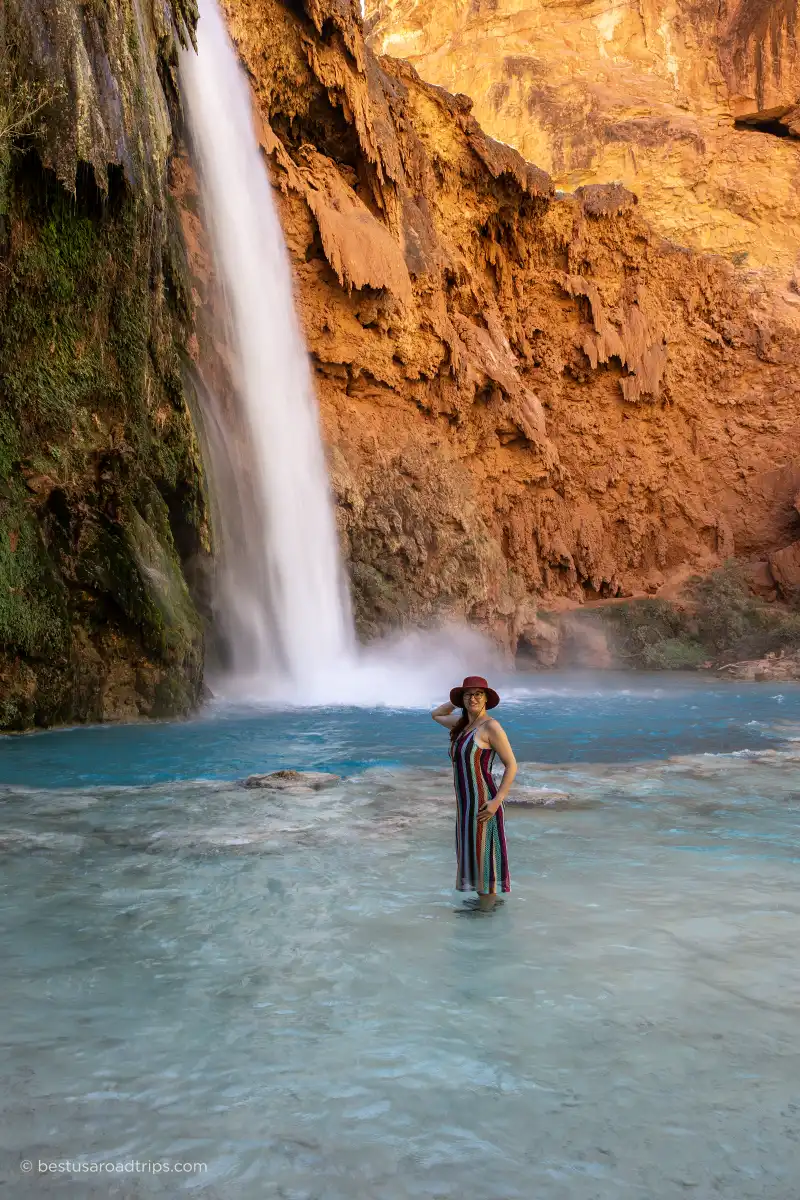
The waterfall drops about 100 feet over a vertical travertine cliff into a large turquoise pool. The contrast between the blue-green water, red canyon walls, and lush greenery makes it one of the most photographed waterfalls in the Southwest.
Havasu Falls is located:
- about 2 miles from Supai Village
- just a 5–10 minute walk from Havasu Falls Campground
Because of its proximity to the campground, this waterfall sees the highest number of visitors throughout the day. The pool below the falls is wide and deep enough for swimming in many areas, and the surrounding banks offer plenty of space to relax, sunbathe, or enjoy the scenery.
Water temperatures typically hover around 65–70°F, which feels refreshing even on hot days. The area is generally calm and suitable for swimming, unlike some of the more powerful waterfalls downstream.
Havasu Falls is easy to access and does not require scrambling or ladders. It’s the most approachable waterfall for visitors of all experience levels and often becomes the central gathering spot during the day.
Mooney Falls
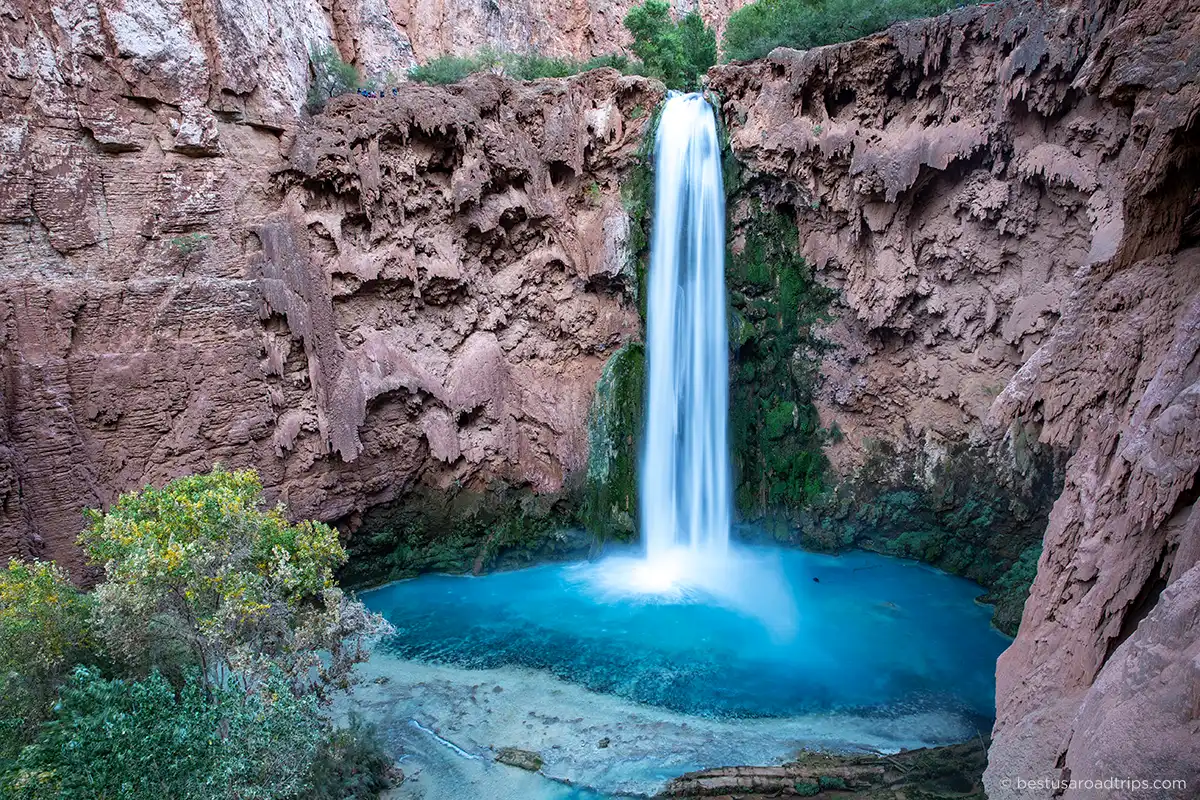
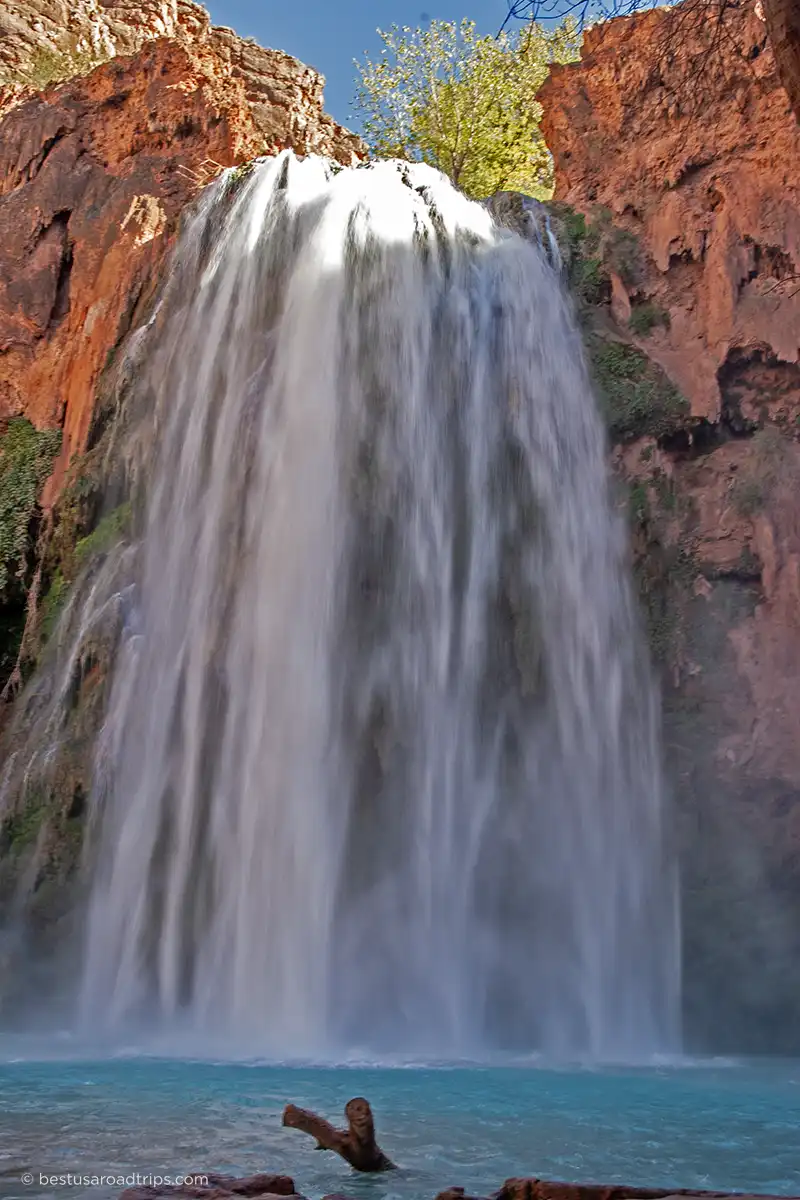
Mooney Falls is the tallest and most dramatic waterfall in Havasu Creek. Plunging nearly 200 feet, it thunders into a narrow canyon below and feels wild and powerful compared to the calmer waterfalls upstream.
Mooney Falls is located:
- just beyond the lower end of Havasu Falls Campground
- a short walk from the campground, but not easy to reach
Reaching the base of Mooney Falls requires a steep, exposed descent that includes tunnels, chains, and ladders carved into the canyon wall. The rocks are often wet and slippery due to constant spray from the waterfall. Because of this, Mooney Falls is not suitable for everyone, especially visitors uncomfortable with heights or slick terrain.
Swimming directly beneath Mooney Falls is not recommended. Strong currents and falling water create dangerous conditions near the base. Many visitors choose to admire Mooney Falls from above or descend carefully only partway for views.
Mooney Falls marks a clear transition point along Havasu Creek. Beyond this waterfall, the canyon becomes more rugged and remote, leading toward Beaver Falls. Those who continue should be prepared for longer hikes, river crossings, and more challenging terrain.

Beaver Falls
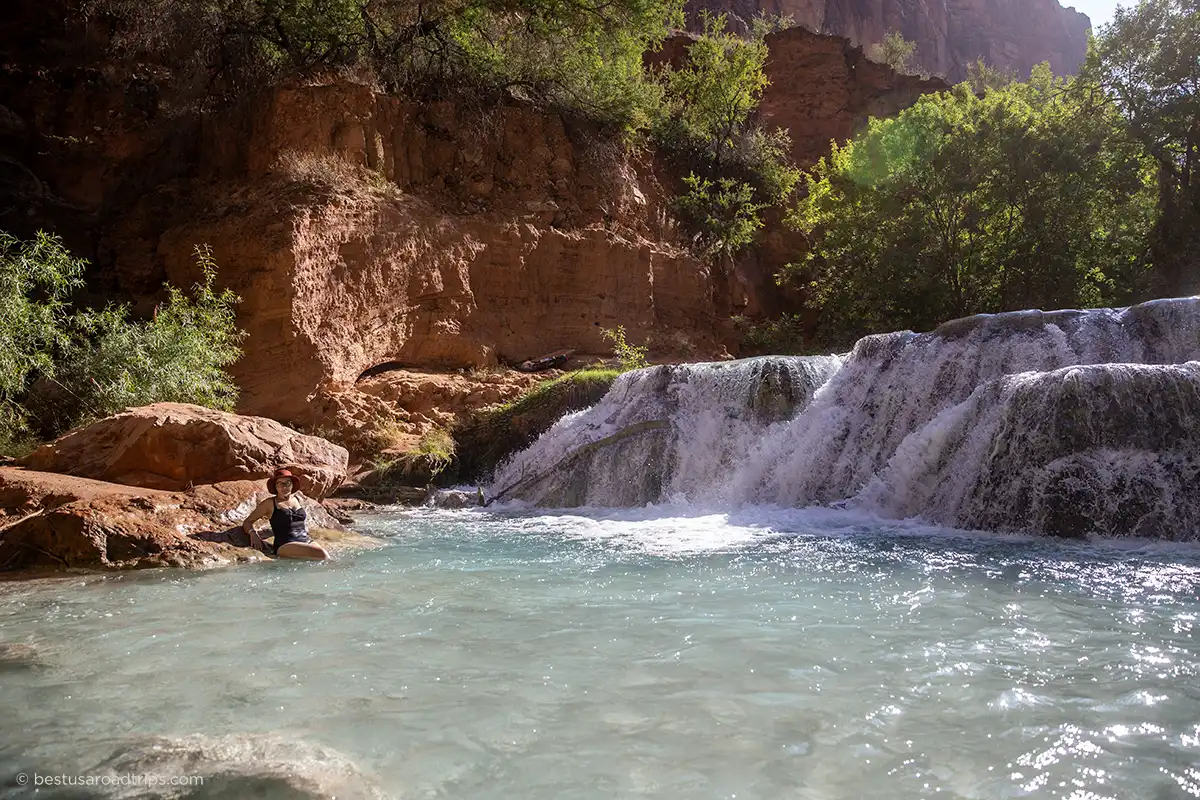
Beaver Falls is the farthest waterfall along Havasu Creek and one of the most rewarding to visit. Instead of a single vertical drop, Beaver Falls features a series of cascading pools and small waterfalls spread across multiple levels, creating a tropical, oasis-like setting deep in the canyon.
Beaver Falls is located:
- about 3 miles downstream from Havasu Falls Campground
- beyond Mooney Falls, deeper into Havasu Creek canyon
This waterfall area is less crowded than Havasu Falls because reaching it requires more time, effort, and experience. The hike includes river crossings, uneven terrain, ladders, and route-finding, so Beaver Falls is best suited for confident hikers who are comfortable spending several hours on the trail.
The pools at Beaver Falls are some of the best swimming spots in the entire Havasupai area. Clear water, small travertine dams, and palm trees give this area a completely different feel from the waterfalls closer to the campground.
Because of the distance and terrain, Beaver Falls is usually visited as a full or half-day outing from the campground. Many visitors choose to turn around here rather than continue farther down the canyon.
Beaver Falls represents the wildest and most remote part of the Havasupai Waterfalls experience—and for many hikers, it becomes the highlight of the trip.

Does One Permit Give Access to All Five Waterfalls?
Yes. One valid Havasupai permit gives you access to all five waterfalls along Havasu Creek.
When you secure a campground or lodge reservation, you are allowed to explore the entire Havasupai Waterfalls area during your permitted stay, including:
- Fifty Foot Falls
- Little Navajo Falls
- Havasu Falls
- Mooney Falls
- Beaver Falls
There are no separate permits required for individual waterfalls. Once you are checked in, wearing your wristband, and legally on Havasupai tribal land, you can hike to and visit any of the waterfalls that your skills, time, and weather conditions allow.
That said, access does not mean obligation.
Some waterfalls, like Havasu Falls, are easy to reach and suitable for most visitors. Others, especially Mooney Falls and Beaver Falls, require comfort with exposure, ladders, chains, river crossings, and longer hiking days. Each visitor must decide which waterfalls are appropriate for their experience level.
How Do You Reach Havasupai Waterfalls?
First and most important, you must have a valid permit to visit Havasupai Waterfalls—permits go on sale each year on February 1, and they typically sell out within minutes due to extremely high demand and limited availability. Havasupai permits for the 2026 season have a presale that begins on January 21.
Reaching Havasupai Waterfalls is part of the adventure—and one of the main reasons this place still feels remote and special. There are no roads, no drive-up viewpoints, and no public transportation to the waterfalls. Every visitor must make a deliberate effort to get there.
First, all visitors must complete mandatory check-in at the official check-in location operated by the Havasupai Tribe. This takes place at Grand Canyon Caverns Inn, located along historic Route 66 near Peach Springs, Arizona. Check-in is required before you are allowed to continue toward the trailhead.
After check-in, you drive 66 miles from the check-in location to the Hualapai Hilltop trailhead, which takes about 1 hour and 15 minutes. This final stretch is remote, with no services, no fuel, and no cell coverage.
From the trailhead, there is no road access into the canyon. The only ways to reach the waterfalls are:
- hiking into the canyon
- limited helicopter service to Supai Village

Hiking to Havasupai Waterfalls
For most visitors, hiking is the primary and most reliable way to reach Havasupai Waterfalls. The hike begins at Hualapai Hilltop and descends into the canyon, passing through Supai Village before continuing to the campground and waterfalls.
Hiking is required even if you:
- stay at Havasupai Lodge
- plan to visit only Havasu Falls
- intend to explore all five waterfalls
Every visitor should be prepared to hike both in and out, regardless of other options.
For full details on distances, elevation, water needs, trail conditions, and how the hike actually feels mile by mile, see our detailed guide:

Helicopter access
Helicopter flights operate between Hualapai Hilltop and Supai Village, but they:
- are weather dependent
- do not run every day
- give priority to tribal members
- cannot be reserved in advance
Because of this uncertainty, helicopter service should never be relied on as a guaranteed form of transportation. Many visitors still need to hike out, even if they fly in.
Pack Mule Services
In addition to hiking and limited helicopter access, the Havasupai Tribe offers pack mule services to carry bags between the trailhead and the campground. The cost is $400 round trip.
While this option exists, we do not recommend using mules unless there is a genuine physical limitation, as the hike is manageable with proper packing and the animals are often heavily burdened in extreme desert heat.

Where Do You Stay When Visiting Havasupai?
There are only two legal places to stay when visiting Havasupai Waterfalls: the campground or the lodge. All reservations are sold as a 3-night stay. Even if you only want to stay one or two nights, you still pay for the full 3-night reservation. Day hiking is not allowed.
Havasu Falls Campground
Most visitors stay at Havasu Falls Campground, located along Havasu Creek between Havasu Falls and Mooney Falls.
Key things to know:
- The campground reservation is 3 nights / 4 days
- If you stay fewer nights, the price does not change ($455 per person in 2026)
- Campsites are first come, first served
- There are no assigned sites
- No showers, electricity, or running water
- Composting toilets and picnic tables are available
Camping here is incredible, but it’s true backcountry-style camping. You must be fully prepared and pack everything you need for sleeping, cooking, and food storage.
We share exactly how the campground works, how to pick the best spot, and what’s prohibited here:
Havasupai Lodge (Supai Village)
The second option is Havasupai Lodge, located in Supai Village, about two miles from the campground and waterfalls.
Important details:
- Lodge stays are also sold as a 3-night reservation ( $2,277 in 2026 for a 3-night reservation – allows up to 4 people per reservation)
- Availability is very limited and competitive
- Rooms do not include a kitchen
- Guests still must hike to reach the waterfalls
Staying at the lodge does not mean you avoid hiking. It simply means you sleep in Supai Village instead of camping near the creek.

When Is the Best Time to Visit Havasupai Waterfalls?
Havasupai Waterfalls are not accessible year-round. Visitor access is seasonal and fully controlled by the Havasupai Tribe.
Official visitor season (important)
- Tourism typically reopens on February 1
- Visitor season runs through late fall (usually November)
- December and January are closed to visitors under the standard permit system
Exact opening and closing dates can change each year based on:
- weather conditions
- flooding damage
- trail safety
- tribal decisions
Always confirm current access conditions on the official Havasupai Tribe website and their official Facebook page before finalizing travel plans.
Spring (February–April)
Spring is one of the best times to visit.
Air temperatures
- Daytime highs: 60–80°F (15–27°C)
- Nighttime lows: 30–45°F (–1 to 7°C)
Water
- Water temperature: about 55–65°F
- Cold for swimming without long exposure
Conditions
- Best season for hiking
- Lowest heat risk
- Low flash-flood probability
This is one of the safest and most comfortable seasons for first-time visitors.
Early Summer (May–June)
Air temperatures
- Daytime highs: 85–100°F (29–38°C)
- Nighttime lows: 50–65°F (10–18°C)
Water
- Water temperature: about 65–70°F
- Ideal for swimming
Conditions
- Hiking becomes physically demanding after sunrise
- Early starts are critical (often before 5:00 a.m.)
- Heat illness risk increases quickly during the day
This is a popular season, but heat management is essential.
Monsoon Season (July–September)
Air temperatures
- Daytime highs: 95–115°F (35–46°C)
- High humidity during storms
Weather risks
- Afternoon thunderstorms common
- High flash-flood risk, even if rain falls miles upstream
- Trail, bridge, and campground flooding possible
Historical context
- Major flood events occurred in 2008 and 2022
- Flooding has destroyed trails, bridges, and campsites in the past
This is the highest-risk season. Weather monitoring and flexibility are mandatory.
Fall (October–November)
Air temperatures
- Daytime highs: 65–85°F (18–29°C)
- Nighttime lows: 35–50°F (2–10°C)
Water
- Water temperature: about 55–65°F
- Cold but manageable for short swims
Conditions
- Reduced flood risk after monsoon season
- Cooler hiking temperatures
- Fewer visitors
Fall offers the best balance of safety, comfort, and crowd levels.
Key safety facts for all seasons
- There is no shade for much of the hike
- There is no water source for the first 8 miles
- Heat illness is the most common medical emergency
- Flash floods can occur without local rainfall
Choosing the right season — and understanding real temperature and flood risks — is one of the most important parts of planning a safe Havasupai trip.
Flooding & Safety in Havasu Creek
Flooding is one of the most serious and well-documented dangers at Havasupai. Havasu Creek flows through a narrow canyon system where water levels can rise extremely fast, even when skies above the waterfalls are clear.
This is not a rare event. Flooding has repeatedly reshaped the canyon and disrupted access.
Flooding in Havasu Creek does not require rain in Havasupai itself—storms occurring many miles upstream can send sudden surges of water through the canyon, causing flash floods with little or no warning. Flash flooding in Havasu Creek can occur even when skies are clear at the waterfalls.
Why flooding happens in Havasu Creek
Havasu Creek drains a large desert watershed. During storms—especially in summer—rain can fall many miles upstream, sending sudden surges of water downstream into the canyon.
Key risk factors include:
- narrow canyon walls with limited escape routes
- steep drainage funnels upstream
- monsoon storms that develop quickly
- debris carried by fast-moving water
Flash floods can occur with little to no warning.
Major flood history (confirmed)
Havasu Creek has experienced several significant flood events that affected both visitors and the Supai community:
- August 2008. A major flood dramatically altered the canyon. Waterfalls changed shape, trails were destroyed, and parts of the area were evacuated. Fifty Foot Falls and Little Navajo Falls were permanently reshaped.
- July 2018. Flash flooding forced helicopter evacuations of visitors from the canyon.
- October 2022. Severe flooding damaged bridges and access routes critical for both tourism and daily life in Supai Village.
- August 2024. Monsoon storms caused another major flash flood, rapidly raising creek levels and forcing evacuations and closures. Tourism was suspended until damage could be assessed and infrastructure repaired.
These are not isolated incidents. Smaller flooding events occur almost every monsoon season.
Highest-risk period: monsoon season
- July through September
- Afternoon thunderstorms are common
- Flooding can occur even if rain falls far upstream
- Creek crossings, ladders, bridges, and campsites can become unsafe quickly
During this period:
- temporary closures are more likely
- trail conditions can change overnight
- evacuation and rescue times are longest
Safety realities visitors must understand
- There is no hospital or emergency medical facility in the canyon
- Rescue and evacuation can take many hours
- Cell service is unreliable or nonexistent
- Trails, ladders, and bridges may close without advance notice
Flood risk is one of the main reasons permits are limited and rules are strictly enforced.
Essential safety practices
- Check weather forecasts daily, including upstream areas
- Avoid narrow canyon sections during storms
- Never camp in low-lying creek beds
- Obey all closures immediately
- Monitor updates from the official Havasupai Tribe–managed Facebook page for real-time alerts on flooding, trail conditions, and safety notices
Flooding risk at Havasupai is real, recurring, and potentially life-threatening. Understanding it—and planning with it in mind—is essential for a safe and responsible visit.

Photography at Havasupai Waterfalls: What to Know
Havasupai is one of the most photogenic waterfall systems we have ever visited. The contrast between turquoise water, red canyon walls, and green vegetation creates incredible scenes. At the same time, photography here comes with real challenges.
- Early mornings offer the best conditions. Light is softer, temperatures are cooler, and crowds are minimal.
- Midday light can be harsh, especially in summer, creating strong contrasts and glare on the water.
- Water spray is common near Havasu Falls and Mooney Falls. Lenses get wet quickly.
- Tripods are useful but require care on wet, slippery rock.
- Drones are strictly prohibited on Havasupai tribal land.
- Floods and seasonal water levels regularly reshape pools, cascades, and shorelines. No visit looks exactly the same.
We photographed all five waterfalls during different times of day, in different seasons, and across multiple visits. Each waterfall looks different depending on light, water flow, and recent weather.
For detailed photography tips, camera settings, timing, and best shooting locations at each waterfall, see our dedicated Havasupai Waterfalls Photography Guide.
Havasupai Tribal Land: Why Rules, Permits, and Respect Matter
Havasupai Waterfalls are not located in a national park or on public land. They are on sovereign tribal land belonging to the Havasupai Tribe, and this distinction is essential to understand—both legally and culturally.
The Havasupai people, whose name means “People of the Blue-Green Waters,” have lived in and around Havasu Creek for more than 800 years. Long before the Grand Canyon became a national park, this canyon, its waterfalls, and its springs were already home to the Havasupai community.
Because this is tribal land, the Havasupai Tribe:
- controls access to the area
- sets permit limits and prices
- establishes all rules and regulations
- manages tourism to protect their land and way of life
This is why:
- permits are mandatory
- day hiking is not allowed
- rules are strictly enforced
- fines and removals can occur if rules are broken
Photography restrictions, alcohol bans, drone prohibitions, camping rules, and behavior expectations are not suggestions. They are tribal laws. Visitors are guests on Havasupai land, not tourists in a public park.
Respect also goes beyond rules. The village of Supai is a living community, not an attraction. Photographing residents, homes, or daily life is prohibited. Quiet behavior, modest clothing, and environmental care are expected throughout the canyon.
Limiting visitor numbers is not about exclusivity. It is about preserving fragile ecosystems, protecting sacred sites, and allowing the Havasupai people to continue living in balance with Havasu Creek.
Understanding this context makes the experience richer. Visiting Havasupai is not just about seeing waterfalls—it is about entering a place with deep cultural meaning and respecting the people who have protected it for generations.

Final Thoughts: Is Havasupai Worth the Effort?
Havasupai Waterfalls are not easy to reach. The permit process is competitive. The hike is long and demanding. The rules are strict. And the planning takes time.
But after visiting three times, we can say this clearly: Havasupai is worth every bit of effort.
Nowhere else in the Southwest combines:
- intense desert landscapes
- vivid blue-green water
- remote canyon hiking
- and deep cultural significance
Seeing Havasu Creek for the first time feels unreal. Swimming below travertine waterfalls after a long hike through the desert is something you don’t forget. Nights at the campground, with water flowing nearby and stars overhead, are quiet and grounding in a way few places still are.
This guide was created to help you prepare properly and respectfully. Not to rush. Not to cut corners. And not to underestimate what this place requires.
If you plan carefully, follow the rules, and respect the land and its people, Havasupai offers an experience that feels truly rare in today’s world.
Do You Like It? Pin It For Later!